
Rest assured that many brilliant parents have gone uncalmly before you. And tomorrow is a whole other day.
How to be the calmest person in the room
Trying for a calmer default can help you feel way less crappy, feel like a much better parent and build stronger bonds with your child.- Remember, they’re hurting, not really trying to hurt you.
- Help your child manage their big feelings by noticing and naming them.
- Share your calm – don’t join their chaos.
- Your child is in crisis, but YOU don’t have to be.
Long-game tips and tricks
Thinking about your long-term relationship with your child and how you are nurturing that (what I like to call long-game thinking) is an opportunity to shift your overall parenting perspective and there are a bunch of different strategies that can help you get closer to being the sort of parent you might want to be. Everyone is different, but perhaps some of these ideas might help you to refresh your way of parenting (and make you feel much more positive about life in general!). 1. Practise ‘S.T.O.P.’ mindfulness This is an easy-to-remember, portable way to practice mindfulness, and one you can share with your school-aged child or teenager. S Stop. Pause for a moment. T Take a few deep breaths in through the nose and out through the mouth. O Observe. Don’t judge or problem-solve, just notice your thoughts and feelings. P Proceed. Continue on. Mindfulness reminds us to be kind, compassionate, and accepting of the moment we are in. 2. Let your face speak what’s in your heart In 2000, the late author Toni Morrison appeared on The Oprah Winfrey Show and shared a huge parenting lesson. “When a kid walks in the room, your child or anybody else’s child, does your face light up?”, Toni asked a group of assembled women. “That’s what they’re looking for,” she said. Toni explained that when your child walks in and sees you checking their physical appearance, they don’t interpret it as a demonstration of your love and care for them. They see your critical face and wonder what they’ve done wrong. She suggested that you should let your face show what’s in your heart, and let your child see that you’re glad to see them. It’s a tiny but powerful shift that can reset your day. And there’s no time like today to begin doing this. 3. Try the ‘I get to’ switch This may seem a little cheesy, but I promise it can help to change your approach, while also modeling excellent positivity and gratitude to (and for) your child. When you catch yourself saying ‘I have to’, try switching it to ‘I get to’ instead. ‘I have to take Sophie to soccer practice’ becomes ‘I get to take Sophie to soccer practice.’ ‘We have to go to the library’ becomes ‘We get to go to the library!’ ‘I have to read Jack a bedtime story’ becomes ‘I get to read Jack a bedtime story.’ ‘I have to pick up Max from his pal’s house’ becomes ‘I get to pick up Max from his pal’s house’ (and also provides an excellent opportunity to chat in the car on the way home!). It’s an easy win, it boosts everyone’s mood and it flips things brilliantly. 4. Approach parenthood as a growth exercise Becoming a parent is a transformative experience and embracing this very steep learning curve with your learner driver plates on can help to reframe any bumps in the road. As author and psychotherapist Philippa Perry points out, a baby has never been a baby before. They’re just learning! It’s no wonder their behavior is hard to predict. Parents are learning, too – parenting each individual child for the first time through all kinds of ages and stages. When you look at things from this point of view, it’s not surprising that you can’t rise effortlessly to every parenting challenge. Every child is different and every day is different. Your child is learning and growing and taking leaps and sometimes retreating a few steps backwards. Your parent skills and responses might be doing the very same thing. If you approach parenting from this ‘learning on your feet’ vantage point, it’s a lot less demoralizing when things don’t go as expected or if you’re unsure of what to do next. I love this fresh idea of reframing parenthood as a period of growing and adapting, rather than a period of loss and/or mastery. Granted, you probably are losing sleep, losing independence, losing money… and for many, parenthood sparks mental and physical health concerns, or makes existing ones worse. There is no doubt that this is incredibly challenging. But there is goodness and growth in parent life, too.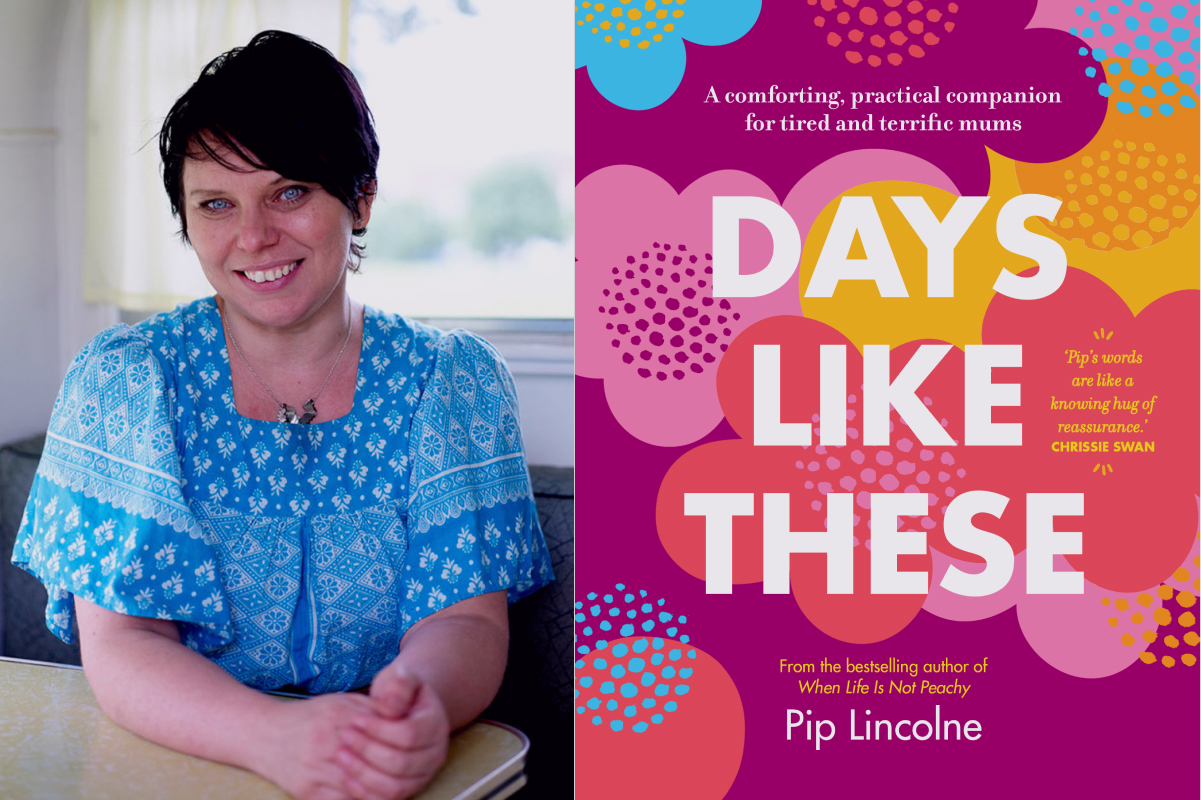 Written by Pip Lincolne. Pip is a Tasmanian-based writer and crafter. She’s published seven books about mental health, creativity, and making things and she would like to write a whole bunch more. She’s Frankie’s craft contributor too! Pip has three kids and a love of toast and tea. Pip likes to make and write every single day.
Edited extract from ‘Days Like These’ by Pip Lincolne. Murdoch Books RRP AU$32.99.
Written by Pip Lincolne. Pip is a Tasmanian-based writer and crafter. She’s published seven books about mental health, creativity, and making things and she would like to write a whole bunch more. She’s Frankie’s craft contributor too! Pip has three kids and a love of toast and tea. Pip likes to make and write every single day.
Edited extract from ‘Days Like These’ by Pip Lincolne. Murdoch Books RRP AU$32.99.